AI Is Modding CDJs: What DIY Firmware Means for the Future of DJ Gear
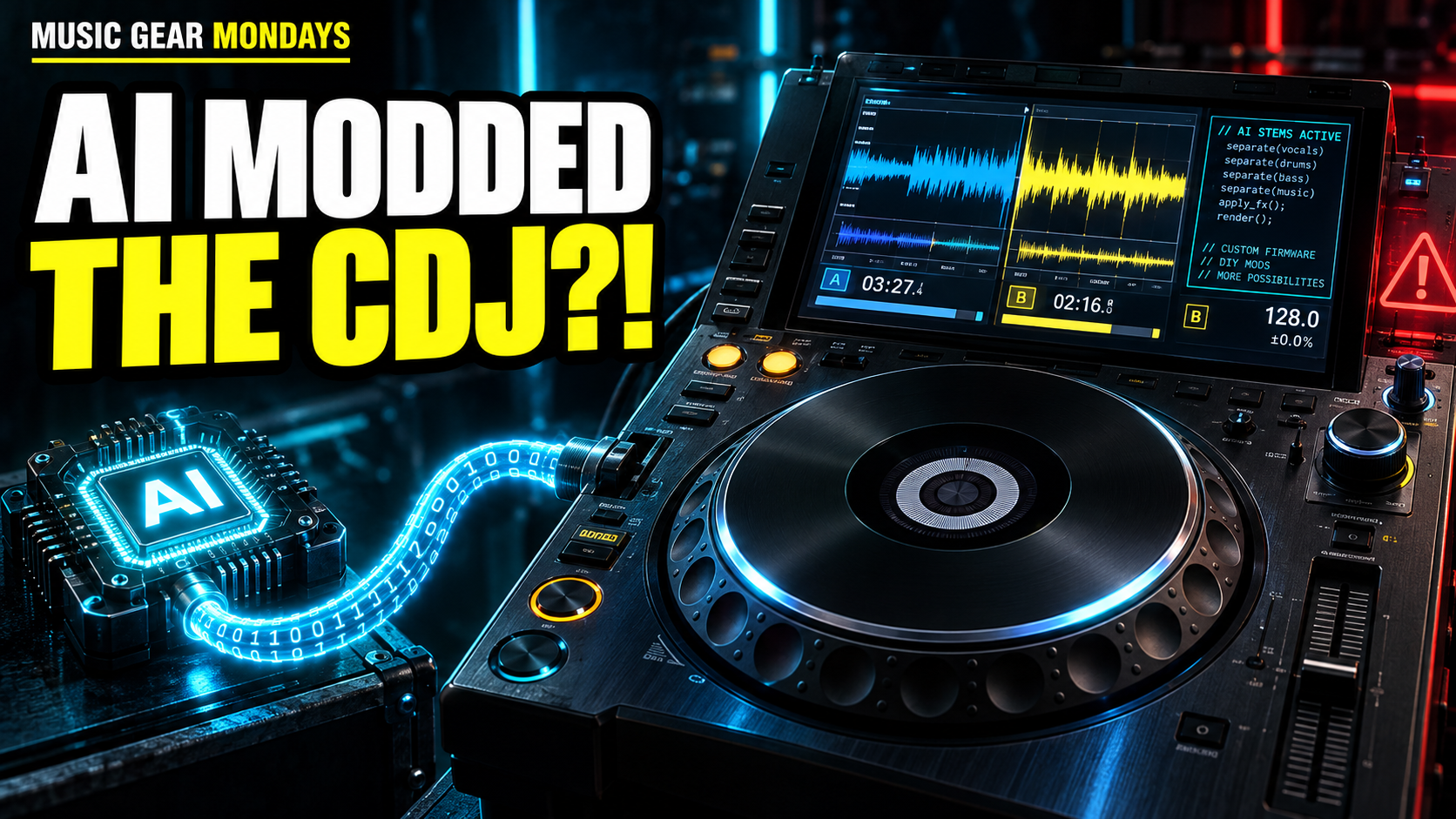
Music Gear Mondays — Presented by Crate Connect
Something interesting—and potentially disruptive—is happening in DJ technology.
Independent developers are using AI coding tools to examine existing hardware, experiment with unofficial firmware, and create workflows that DJs have been asking major manufacturers to deliver. Features demonstrated online include stems controls, Day Mode, Gate Cue, and expanded cue options on modern club players.
This does not mean rekordbox, AlphaTheta, or Pioneer DJ is about to disappear. It does mean the distance between a product idea and a working experiment is getting shorter.
When one motivated creator can use an AI assistant to prototype a feature, established manufacturers may face more pressure to explain why requested features are missing, delayed, or reserved for a later product cycle.
AI Is Lowering the Barrier to Experimentation
Developing embedded software has traditionally required specialized knowledge, time, and access to documentation. AI does not remove those requirements, but it can help a technically capable creator understand unfamiliar code, generate test approaches, troubleshoot errors, and move through an experiment faster.
That is what makes the unofficial CDJ work shared by @themanleone worth watching. The project has demonstrated custom workflows on CDJ-3000-series hardware and sparked a larger conversation about what the hardware may already be capable of doing.
There is an important technical distinction, however: controlling preprocessed stem files is not the same as asking a player to separate a finished track into stems in real time. Real-time separation can require significant processing power. Anyone who has pushed stems heavily in Serato DJ Pro or rekordbox has probably seen how demanding the feature can be on a computer.
That distinction does not make the experiment less interesting. It simply helps set accurate expectations about what the hardware and firmware are doing.
Why I Would Not Modify My Rental Gear
I am a fan of technology, experimentation, and independent creators. I also rent my DJ equipment to working professionals.
For that reason, I will not install unofficial firmware on my CDJs, XDJ-AZ, or rental inventory. My equipment needs to remain compatible with current rekordbox exports, supported updates, venue workflows, and client expectations.
Unofficial firmware may introduce several risks:
An interrupted or failed installation could make a device unusable
Future official updates may not install correctly
Software, USB-export, or Pro DJ Link compatibility could change
Manufacturer support or warranty coverage may be affected
Experimental features may not be stable enough for a paid event
For a personal lab or test device, those risks may be part of the fun. For rental gear or a mission-critical performance setup, reliability comes first.
If AlphaTheta releases an official update with the features I need, I can test it and update through the supported process. Until then, I am watching the DIY movement without putting client equipment at risk.
DIY DJ Hardware Is Bigger Than Firmware
The current conversation is not limited to CDJs. There has been an underground community building custom MIDI controllers, software mappings, performance tools, and alternative DJ hardware for years.
The MIDI Fighter helped show how a controller could be designed around a particular performance style instead of copying a standard pair of decks. Open-source projects such as Traktorino made it possible for creators to study, build, and customize their own MIDI hardware. More recent community projects continue that idea with accessible microcontrollers, 3D printing, and software such as Mixxx.
The NAP Works Devious Pocket pushes the discussion in another direction by offering a compact, laptop-free DVS workflow. Products like this are interesting because they are not merely adding another deck layout; they are reconsidering what a digital DJ system needs to be.
As AI tools, small-run manufacturing, and open-source development become more accessible, we are likely to see more specialized gear built for workflows that may be too narrow for the largest companies to prioritize.
Will DIY Development Push the Major Brands?
AlphaTheta and Pioneer DJ equipment remains deeply established in clubs, festivals, venues, and professional booths. That market position will not disappear because of a few custom projects.
But independent experiments can change customer expectations.
When creators demonstrate that an existing device can support a new workflow, DJs naturally ask whether a manufacturer could have delivered it officially. That leads to uncomfortable but useful questions:
Is a feature missing because the hardware cannot support it?
Is the limitation about stability, licensing, testing, or support?
Is the company protecting a future product release?
Would the feature create a poor experience without upgraded hardware?
How long should customers wait for an official solution?
The public does not always see the engineering, licensing, quality-assurance, and support work behind a reliable commercial release. At the same time, major companies should expect more pressure when small developers can demonstrate working alternatives in public.
The healthiest outcome would be faster innovation, clearer communication, and more official support for customization.
Better Gear Still Does Not Make a Better DJ
There is another side to this conversation.
Stems, larger screens, custom firmware, and new controllers can expand what a DJ is able to do. They do not automatically improve music selection, phrasing, timing, programming, transitions, or the ability to read a room.
DJ culture can become so focused on equipment that the craft gets pushed into the background. The most important work still happens when a DJ searches for music, develops taste, creates a thoughtful set, and gives the audience something worth remembering.
Technology and craft do not have to compete. The best tools should make it easier to express an idea—not become a substitute for having one.
Final Thoughts
I am excited to see independent developers challenge the assumptions built into modern DJ gear. AI-assisted coding, open-source projects, and small hardware companies can introduce ideas that move the entire industry forward.
I am also going to keep my working and rental equipment on supported firmware.
That is the balance: stay curious, support experimentation, understand the technical limitations, and protect the gear you depend on.
Watch the full episode and tell me: Would you install unofficial firmware on your DJ gear, or wait for the manufacturer to release the feature officially?
Watch the Episode
Embed the YouTube video here
Projects Mentioned
Important: The firmware modifications discussed here are unofficial experiments, not endorsed by AlphaTheta or Pioneer DJ. Installing unofficial firmware may create reliability, compatibility, warranty, security, or recovery risks. Research carefully and proceed at your own risk.
Presented by Crate Connect
Keep your DJ library fresh with Crate Connect:
https://crateconnect.com
Use code MUSICGEARMONDAYS to save $5 on your subscription.
Gear I Use & Recommend
Shop my DJ and music-production picks on Amazon:
https://www.amazon.com/shop/crlcrrll
Stay Connected
Music Gear Mondays:
https://www.musicgearmondays.com
Subscribe on YouTube:
https://www.youtube.com/@musicgearmondays
Join my email list:
https://www.crlcrrll.com/support
Free plugins:
https://www.musicgearmondays.com/plugins
Twitch—Mondays at 6 PM MST:
https://www.twitch.tv/crlcrrll
Affiliate disclosure: Some links in this post are affiliate links. If you purchase through them, I may earn a commission at no additional cost to you. Crate Connect is a Music Gear Mondays sponsor.
CRL CRRLL